
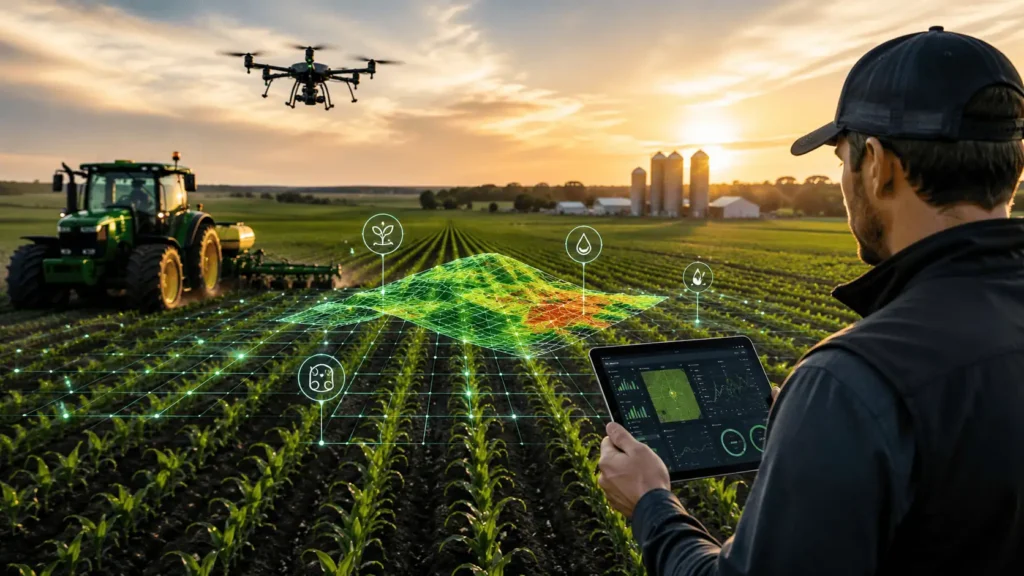
Precision agriculture statistics in 2026 show a clear trend: modern farms are moving from scattered digital tools to connected, data-driven management systems. Farmers are no longer looking at precision agriculture as a luxury or a niche upgrade. They are using it to manage tighter margins, labor shortages, input costs, weather variability, crop performance, livestock records, equipment use, and financial decisions with greater accuracy. As more operations adopt sensors, GPS guidance, mapping, automation, mobile software, and farm management platforms, precision agriculture is becoming a practical requirement for farms that want to stay competitive.
What Precision Agriculture Means in 2026
Precision agriculture uses technology to measure, track, and manage farm activity with a higher level of detail. Instead of making decisions based only on field averages or seasonal habits, farmers use real-time data and historical records to make more accurate choices.
In 2026, precision agriculture includes tools such as:
- GPS guidance and auto-steering
- Yield monitors and yield maps
- Variable rate application
- Soil mapping and field zoning
- Equipment tracking
- Crop scouting tools
- Weather monitoring
- Livestock management software
- Digital task management
- Farm financial tracking
- Remote sensing from drones, satellites, and aircraft
- Farm management software that connects operations in one system
The biggest shift is not just the use of individual tools. The real change is integration. Farms are trying to connect agronomy, labor, equipment, inventory, livestock, finances, and production records in one place. That is where farm management software has become central to the precision farming conversation.
Precision Agriculture Market Growth
The precision agriculture market continues to expand because farms need better visibility and faster decision-making. Industry forecasts vary, but several reports point to strong double-digit growth through the rest of the decade.
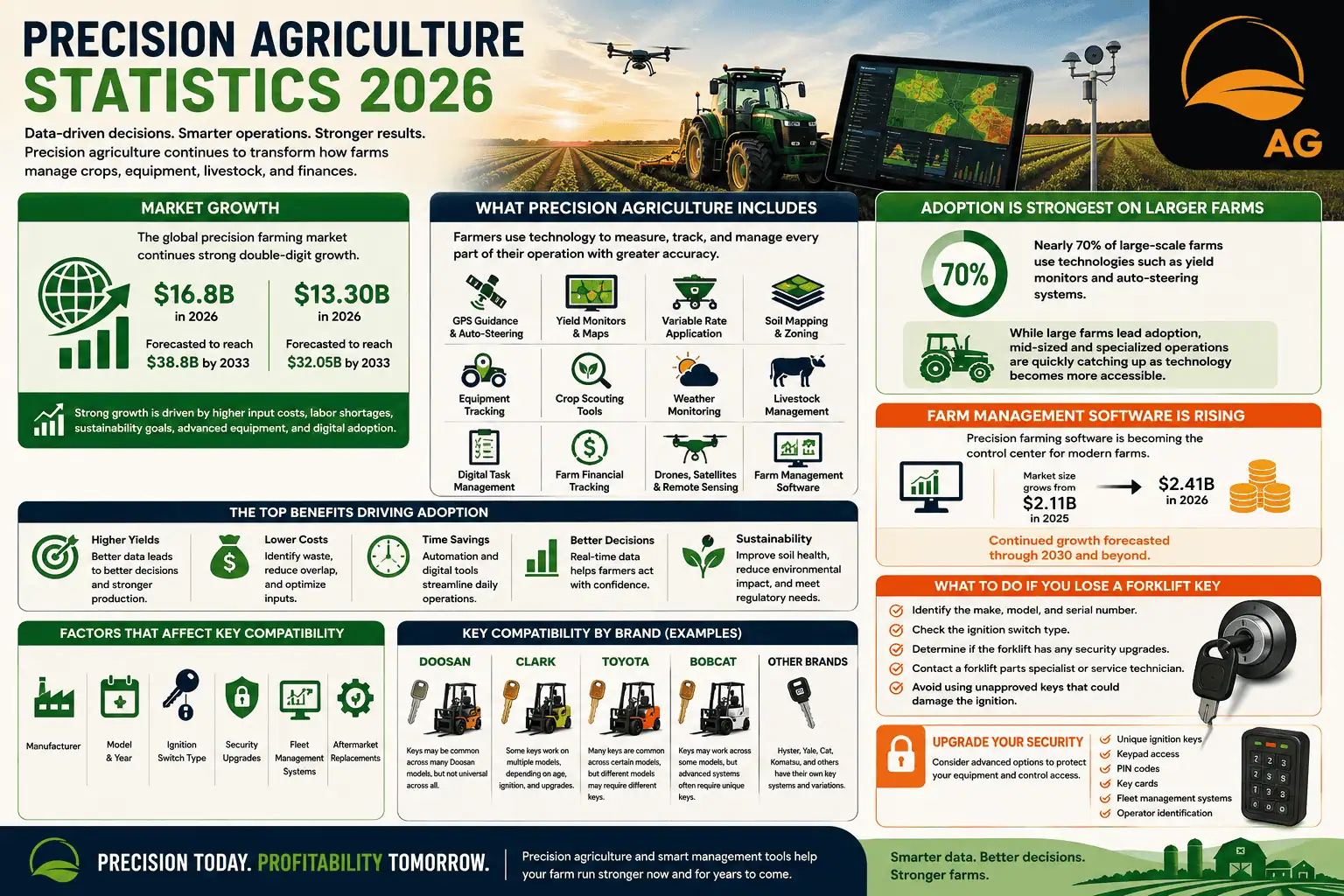
One market estimate places the global precision farming market at about $16.8 billion in 2026, with projected growth to $38.8 billion by 2033. Another forecast estimates the global precision farming market at $13.30 billion in 2026, reaching $32.05 billion by 2033. Although the exact figures differ by methodology, the direction is consistent. Precision farming is growing quickly, and software is becoming a larger part of that growth.
This growth is being driven by several pressures:
- Higher input costs
- Need for improved yield performance
- Labor shortages
- Increased focus on sustainability
- Greater demand for digital records
- More advanced equipment capabilities
- Better access to cloud-based platforms
- Rising use of mobile devices in farm operations
Farmers are under pressure to do more with less. Precision agriculture helps them identify waste, reduce errors, and make decisions based on field-level and operation-wide data.
Adoption Is Strongest on Larger Farms
Precision agriculture adoption is not equal across all farm sizes. Large farms are typically faster to adopt advanced tools because they have more acres, equipment, staff, and operational complexity to manage. For larger operations, even a small improvement in input efficiency, labor planning, or yield performance can create a meaningful financial impact.
Recent USDA-related reporting found that nearly 70% of large-scale farms use technologies such as yield monitors and auto-steering systems. These tools are especially useful for operations that manage large field areas, multiple operators, and high-value equipment.
However, precision agriculture is no longer only for the largest farms. As software becomes easier to use and more affordable, mid-sized and specialized operations are also adopting digital systems. Grain, vegetable, pasture, forage, and livestock operations all benefit from better recordkeeping and clearer visibility across the business.
Farm Management Software Is Becoming the Control Center
One of the most important precision agriculture statistics for 2026 is the growth of precision farming software. The precision farming software market is expected to grow from about $2.11 billion in 2025 to $2.41 billion in 2026, with forecasts showing continued growth through 2030.
This matters because hardware alone does not solve every farm management problem. A tractor with GPS, a grain cart scale, a weather station, or a yield monitor can produce valuable data, but that data needs to be organized and used. Farm management software helps turn that information into decisions.
A strong farm management system can help farmers:
- Track field activity
- Manage crop plans
- Organize livestock records
- Schedule staff
- Monitor equipment
- Track input usage
- Manage harvest logistics
- Connect financial records
- Review production history
- Improve accountability across teams
In 2026, farmers are not just asking whether they can collect data. They are asking whether they can use that data quickly enough to improve daily decisions.
Crop Management and Precision Agronomy Lead Software Demand
Crop management and precision agronomy remain leading application areas in farm management software. This makes sense because crop production creates a large volume of data across every season. Planting dates, seed varieties, fertilizer rates, chemical applications, irrigation records, scouting notes, harvest loads, yield results, and field maps all need to be tracked.
When this information is stored in separate spreadsheets, notebooks, text messages, or equipment displays, it becomes difficult to use. A centralized software platform makes the information easier to review and act on.
Precision agronomy helps farmers answer practical questions, such as:
- Which fields are producing the strongest returns?
- Where are input costs too high?
- Which areas need different fertility plans?
- Are staff and equipment being used efficiently?
- Which crops or varieties performed best under current conditions?
- What operational changes should be made next season?
Better records lead to better decisions. Better decisions lead to better profitability.
Equipment and Labor Tracking Matter More Than Ever
Precision agriculture is often associated with crops and yields, but labor and equipment management are just as important. In 2026, many farms face tight labor availability and rising equipment costs. Managing these resources well can have a direct impact on profitability.
Farmers need to know where equipment is, what it is doing, who is operating it, how much work has been completed, and whether tasks are being done on schedule. They also need to coordinate teams during time-sensitive windows like planting, spraying, cutting, baling, hauling, and harvest.
Farm management software can support better coordination by helping managers:
- Assign tasks clearly
- Track field progress
- Reduce duplicated work
- Improve communication between operators
- Monitor equipment activity
- Keep better maintenance records
- Reduce downtime
- Improve harvest logistics
Precision farming is not only about applying the right input to the right acre. It is also about getting the right people and equipment in the right place at the right time.
Livestock Management Is Part of Precision Agriculture
Precision agriculture is not limited to row crops. Livestock operations also need better data. Pasture, forage, and dairy operations depend on accurate records for animals, feed, land use, labor, equipment, and finances.
Precision livestock and forage management can help farms monitor:
- Herd records
- Grazing rotations
- Feed inventory
- Forage production
- Pasture performance
- Staff activity
- Equipment use
- Costs by enterprise
- Production trends
As pasture, forage, and dairy operations become more data-driven, integrated software will become more important. A farm that manages both land and livestock needs a system that can connect those areas instead of treating them as separate businesses.
Data Integration Is the Main Challenge
Many farms already use some form of precision technology. The challenge is that tools often do not work together cleanly. Data may live in different apps, devices, machines, spreadsheets, and paper records. This creates friction and limits the value of the technology.
Common issues include:
- Duplicate data entry
- Inconsistent field records
- Delayed reporting
- Poor visibility between office and field teams
- Equipment data that is difficult to interpret
- Financial records that are disconnected from production records
- Staff relying on memory instead of documented workflows
In 2026, the most successful precision farming operations will be the ones that simplify their technology stack. A farm does not need more disconnected systems. It needs one reliable operating platform that brings critical information together.
Why Precision Agriculture Statistics Matter to Farm Profitability
Statistics are useful because they show where the industry is heading. The growth of precision agriculture is not just about technology adoption. It reflects a larger business reality: farms need better control.
Precision farming can support profitability by helping farms:
- Reduce unnecessary input use
- Improve yield consistency
- Make faster operational decisions
- Reduce downtime
- Improve labor efficiency
- Strengthen financial planning
- Improve compliance and recordkeeping
- Track performance by field, crop, herd, or enterprise
- Identify problems earlier
- Plan future seasons with better historical data
The goal is not to collect data for its own sake. The goal is to use accurate information to run a more profitable, efficient, and resilient farm.
Key Precision Agriculture Statistics for 2026
The following statistics summarize the direction of the market:
- The global precision farming market is forecast in the range of about $13 billion to $17 billion in 2026, depending on the research source.
- Some forecasts project the global precision farming market to exceed $30 billion by 2033.
- The precision farming software market is projected to grow from about $2.11 billion in 2025 to $2.41 billion in 2026.
- Large-scale farms are adopting precision agriculture faster than smaller farms.
- Nearly 70% of large-scale farms use technologies such as yield monitors, mapping tools, and auto-steering systems.
- Crop management and precision agronomy remain major drivers of farm management software demand.
- Precision farming applications represent a major share of the broader smart farming market.
These numbers show that precision agriculture is moving into the mainstream. More farmers are recognizing that digital management is not just about modernizing. It is about protecting margins and making the farm easier to manage.
What Farmers Should Look for in Precision Agriculture Software
Choosing the right platform matters. A farm management system should simplify daily work, not create another layer of complexity.
Farmers should look for software that offers:
- Easy setup and daily usability
- Crop, livestock, staff, equipment, and financial management
- Field mapping and activity tracking
- Mobile access for operators and managers
- Strong reporting tools
- Clear task management
- Equipment and logistics visibility
- Support for multiple farm types
- Practical features built around real farm workflows
- A platform that can scale as the operation grows
The best software is not the one with the longest feature list. It is the one the team will actually use every day.
FAQ
What is precision agriculture?
Precision agriculture is the use of technology, data, and digital tools to manage farm operations more accurately. It can include GPS, mapping, sensors, equipment tracking, yield monitoring, variable rate application, and farm management software.
Why is precision agriculture growing in 2026?
Precision agriculture is growing because farmers need to improve efficiency, reduce waste, manage labor challenges, control input costs, and make better decisions with accurate data.
Is precision agriculture only for large farms?
No. Large farms often adopt precision technology faster, but smaller and mid-sized farms can also benefit from better records, improved planning, and simplified management.
What is the role of farm management software in precision agriculture?
Farm management software organizes crop, livestock, staff, equipment, financial, and field data in one system. It helps farmers turn raw data into practical decisions.
What are the biggest benefits of precision farming?
The biggest benefits include better input efficiency, improved productivity, stronger recordkeeping, better team communication, lower waste, and more informed financial planning.
Does precision agriculture help with livestock operations?
Yes. Precision agriculture can support livestock operations through herd records, feed tracking, pasture management, equipment monitoring, labor planning, and financial reporting.
What should farmers consider before choosing precision farming software?
Farmers should consider ease of use, available features, support, compatibility with their operation type, mobile access, reporting tools, and whether the software can manage the whole farm rather than just one part of it.
Simplify Your Farming Operation With PIPE AG
Precision agriculture is no longer optional for farms that want stronger control, better data, and more profitable decisions. The numbers show that farms are adopting smarter tools, but the real advantage comes from using a system that brings everything together.
Simplify your farming operation with PIPE AG, the most comprehensive Farm Management Software on the market. Manage livestock, crops, staff, finances, and equipment, all in one easy-to-use farm management software. We have dedicated editions for Grain/Vegetable and Pasture/Forage farming operations, with Dairy just around the corner. The software is loaded with dozens of farm management software features, giving you everything you need to run a profitable smart farm with precision farming.
Contact us today for a demo and see how one connected platform can help you manage your farm with greater clarity, efficiency, and confidence.